
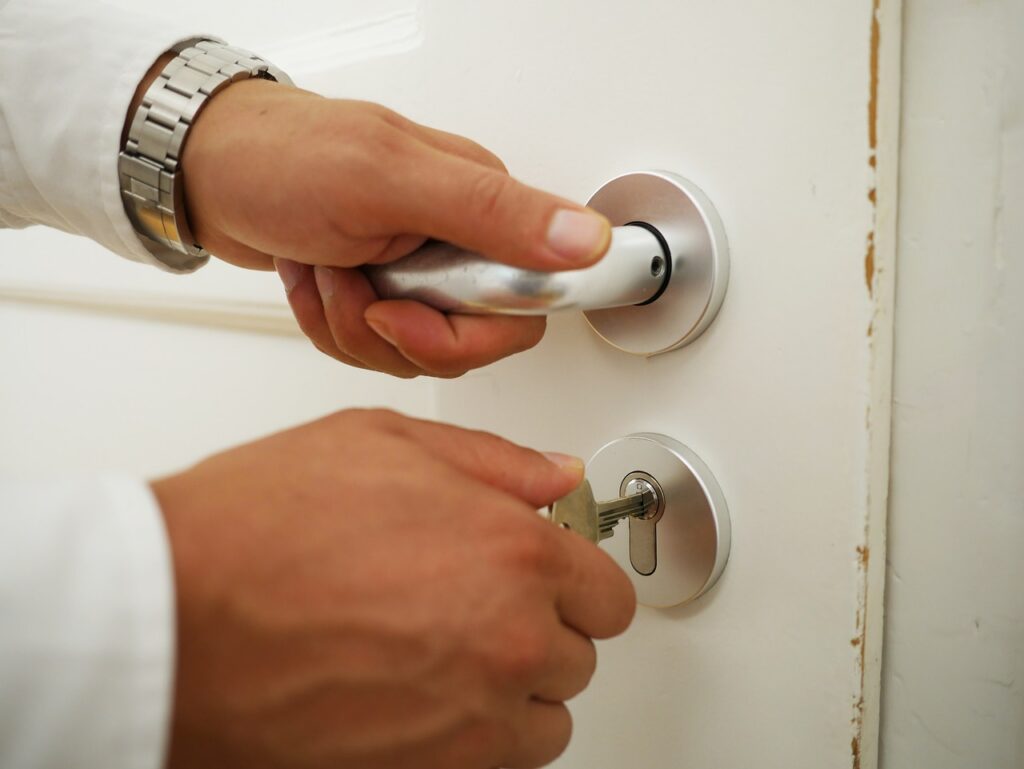
Have you ever left the house and then gone back multiple times to check the door, the oven, or the taps, even though you know they are off? Or found yourself stuck checking messages, replaying conversations, or asking for reassurance, trying to feel certain nothing has gone wrong? At first, it can feel like you are just being careful. But over time, it can become exhausting, time consuming, and difficult to switch off.
This is often how checking OCD shows up.
In this post, I will explain why the urge to check feels so real, what keeps it going, and how you can begin to step out of the cycle. If you recognise yourself in this, you are not alone and there is a way to work through it.
The Truth About Checking OCD
At its core, checking is about trying to gain certainty and prevent something bad from happening. It is a way of trying to make sure something did or did not happen. For example:
‘Did I lock the door properly’
‘Did I turn off the oven, taps, or hairdryer’
‘Did I accidentally hurt someone’
‘Did I say something wrong’
While checking might feel logical in the moment, in OCD it becomes repetitive, time consuming, and exhausting. Over time, it starts taking up more of your time, energy, and attention.
From a CBT perspective, checking is driven by key beliefs such as:
- Inflated responsibility: Feeling personally responsible for preventing harm
- Overestimation of threat: Believing something bad is more likely or more serious than it actually is
- Intolerance of uncertainty: Feeling unable to cope without being completely sure
Research shows that checking is one of the most common compulsions in OCD, which highlights how many people struggle with this, even if it feels isolating (Rasmussen and Eisen, 1992; Ruscio et al., 2010).
If you recognise yourself in this, these are very common patterns in OCD and they can be worked on. You can read more about how CBT works here → [What is CBT]
Common Checking Behaviours in OCD
Common Checking Behaviours in OCD
Checking in OCD is not just about doors or appliances. It can show up in different ways, often driven by fear, doubt, or a need to feel certain. Examples of some themes are:
Safety
Checking doors, windows, or locks repeatedly
Checking appliances such as ovens, taps, or irons
Using photos or videos to confirm everything is as it should be
Mistakes
Reviewing work, emails, or messages excessively
Rereading texts multiple times
Checking with others that you did not say or do something wrong
Health and body checking
Checking your body for signs of illness
Monitoring physical sensations closely
Searching symptoms repeatedly
Avoidance linked to checking
Avoiding situations where you feel it might trigger your anxiety, for example not being the last one out the house so you don’t have to lock up.
When does checking become OCD?
Checking becomes part of OCD when it is:
- Repetitive and difficult to resist
- Driven by anxiety or intrusive thoughts
- Time consuming
- Interfering with daily life
Common Beliefs That Keep Checking OCD Going
Belief 1: “This is just me being responsible”
There is a difference between being responsible and being stuck in a cycle.
Being careful usually means checking once and moving on. With OCD, checking is driven by anxiety and doubt, so it does not resolve the worry and instead keeps it going.
You might check the door, walk away, and then feel a surge of doubt such as what if I did not check properly and something bad happens and it is my fault. This pulls you back into checking again.
Belief 2: “If I do not check, something bad will happen”
This belief is closely linked to feeling responsible for preventing harm.
It can feel like checking is the only thing stopping something bad from happening. But checking actually strengthens the belief that you must be in control at all times.
It also means you never get the chance to find out what happens if you do not check.
In therapy, this belief is gradually tested in a supported way so you can learn from experience rather than fear.
Belief 3: “Checking helps, so it must be useful”
Checking does reduce anxiety in the short term, which is why it sticks.
Over time, it often starts taking more from you. What begins as a quick check can turn into multiple checks, routines, or something you feel unable to leave the house without doing.
The cycle often looks like this:
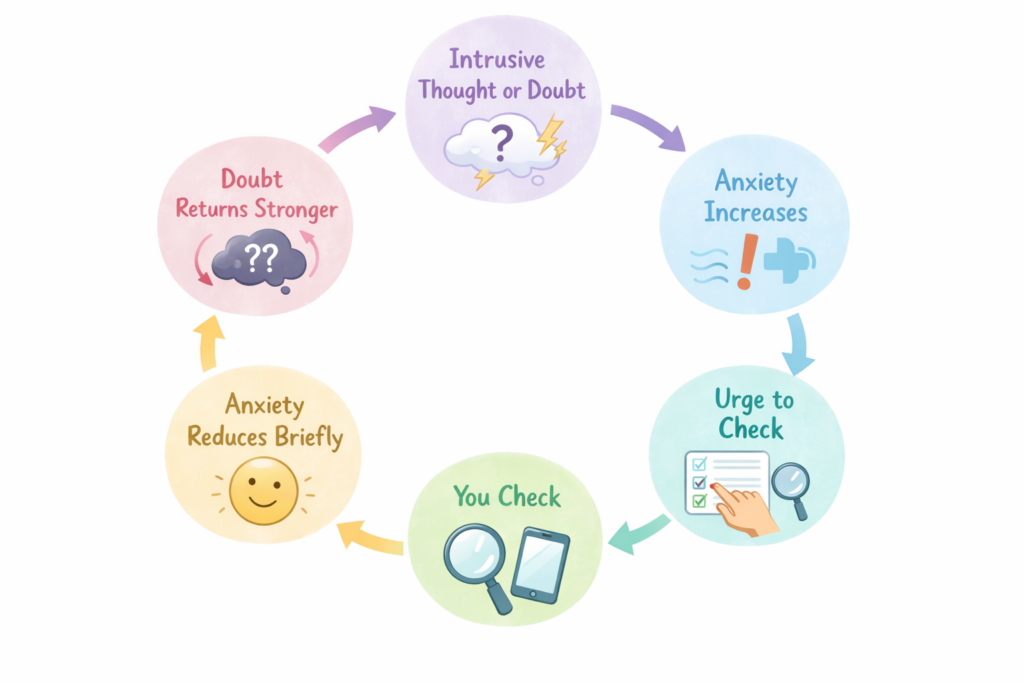
What starts as something small can gradually take over more of your day.
Belief 4: “I should be able to just stop”
If it were that simple, you would have already done it.
When your brain perceives a threat, it responds as if something dangerous is happening. It makes sense that it pushes you to act.
Trying to stop without the right tools often makes the thoughts louder and the anxiety stronger. This is why a different approach is needed, rather than trying to force yourself to stop.
Belief 5: “Something is wrong with me”
It can feel like you should be able to trust yourself, and that something is wrong if you cannot.
But this is not about something being wrong with you. It is about how OCD amplifies doubt and uncertainty.
Even when you know something is fine, the doubt feels real and convincing.
This is not a personal failing. It is a pattern your brain has learned, and it can be unlearned.
Why Checking OCD Develops and Persists
Checking can begin for many different reasons.
For some people, it follows a life event such as a break in, hearing about a fire, or a situation where safety felt threatened. For others, it may be linked to responsibility, caring for others, or behaviours learned growing up.
It often develops gradually. At first, checking may feel helpful or quick. Over time, it grows and begins to demand more in order for you to feel okay.
It also persists because it can look like normal caution, people do not often talk about intrusive thoughts, and advice such as just stop checking is common but not helpful.
How to Break the Cycle of Checking
If you are stuck in a checking cycle, the goal is not to stop everything at once. That usually backfires.
Instead, a gradual and structured approach works better.
You can start by:
- Noticing the urge to check rather than acting on it straight away
- Asking what the checking is trying to achieve
- Allowing a small amount of uncertainty
- Gradually delaying checking
These are the kinds of patterns that can be worked on in therapy, at a pace that feels manageable.
If checking is taking up your time, energy, or peace of mind, you do not have to keep managing it on your own.
There are clear ways to understand and work through these patterns so they no longer have the same hold over you.
If you would like support with this, you can learn more about how CBT can help on my website, or get in touch to book an initial appointment.
References
Morrison, N., & Westbrook, D. (2013). Obsessive compulsive disorder. In J. Bennett Levy et al. (Eds.), Oxford Guide to Behavioural Experiments in Cognitive Therapy. Oxford University Press.
Bream, V., Challacombe, F., Palmer, A., & Salkovskis, P. (2017). Cognitive behavioural therapy for obsessive-compulsive disorder. Oxford University Press.
Ready to start CBT for OCD?
Book a free 15minute consultation