
UNDERSTANDING THE APPROACH
What is Cognitive Behavioural Therapy (CBT)?
CBT is one of the most well-researched psychological therapies. Here's what it actually is, how it works, and whether it's likely to be right for you.
The short version
CBT (Cognitive Behavioural Therapy) is a structured, time-limited psychological therapy. It's focused on the present, on understanding and changing the patterns of thought and behaviour that are keeping a problem going, rather than on exploring the distant past.
The underlying idea is straightforward: the way we think about situations affects how we feel, and how we feel affects what we do. And what we do often maintains or worsens the original problem. CBT works on all three → thoughts, feelings, and behaviours, but particularly on the thoughts and behaviours, because those are what we can most directly change.
The CBT model
💭
Thoughts
"This symptom means something is seriously wrong"
❤️
Feelings
Anxiety, fear, dread, helplessness, sadness, worry...
🏃
Behaviours
Checking, googling, avoiding, reassurance-seeking
↑↓↑
These three interact in a loop. CBT identifies which parts of the loop are maintaining the problem and targets them directly.
What CBT is not
CBT often gets misrepresented. It's not about forcing yourself to "think positively" or dismissing real concerns. It's not about telling you your feelings are irrational. And it's not about talking through your childhood for years until some insight emerges.
CBT is practical and active. Sessions have structure. You'll understand what we're doing and why. And the work continues outside sessions, in your daily life, with specific tasks and experiments you'll try between appointments.
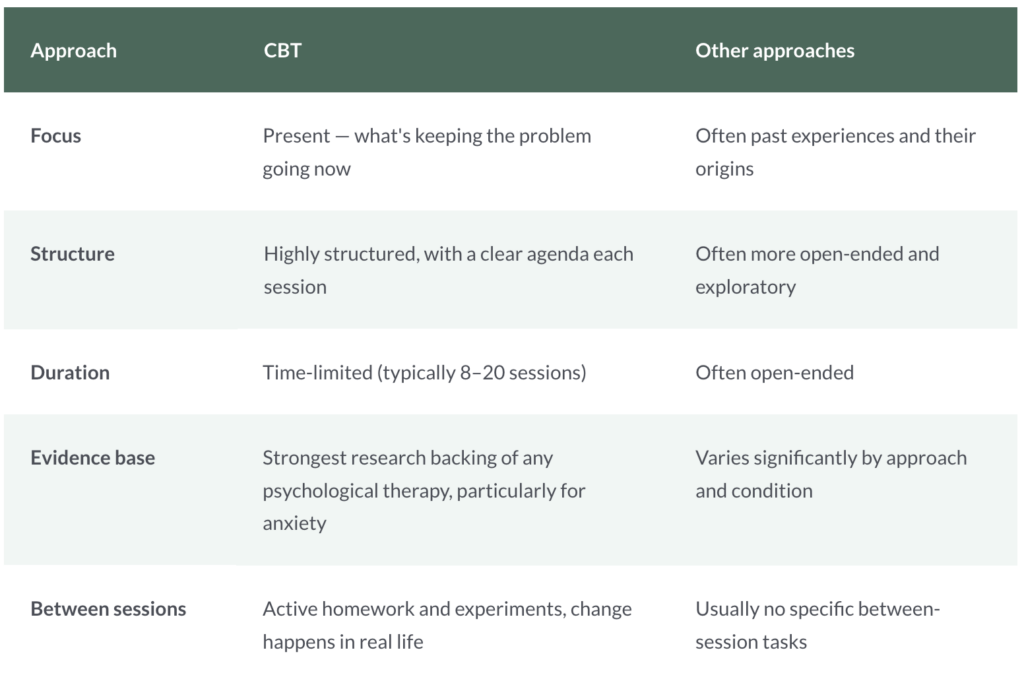
How it compares to other therapies
Approach
CBT
Other approaches
Focus
Present — what's keeping the problem going now
Often past experiences and their origins
Structure
Highly structured, with a clear agenda each session
Often more open-ended and exploratory
Duration
Time-limited (typically 8–20 sessions)
Often open-ended
Evidence base
Strongest research backing of any psychological therapy, particularly for anxiety
Varies significantly by approach and condition
Between sessions
Active homework and experiments, change happens in real life
Usually no specific between-session tasks
IN PRACTICE
What actually happens in CBT sessions
Sessions are 60 minutes. We usually start with an agenda, what we're going to work on that session, and review any between-session tasks from last time.
In early sessions, we spend time understanding your specific difficulty in detail. Not just what the problem is, but exactly how it works; what triggers it, what happens internally (thoughts, feelings, physical sensations), and what you do in response. This is called a formulation, and it's the foundation of everything else.
Once we have a clear formulation, we know what to target. We'll use a range of techniques depending on what's maintaining the problem, these might include working directly with anxious thoughts, behaviour experiments, gradual exposure, or reducing compulsive behaviours. Everything is explained and collaborative.
Between sessions, you'll have specific things to try or notice. This is where the real change happens, in your daily life, not just in the hour we spend together each week.
On homework: "Homework" sounds off-putting. In practice, it's things like: keeping a thought diary, trying a specific new behaviour, or doing a short experiment to test a belief. The tasks are chosen because they're relevant to what you're working on, they're not arbitrary. And we review how they went together.
How long does CBT take?
CBT is a time-limited therapy. That's intentional, the goal is for you to become your own therapist over time. For anxiety difficulties, NICE guidance recommends between 6 and 20 sessions depending on the specific condition and severity. Most people I work with see meaningful change within that range.
I'll give you a realistic estimate in the first session based on what you're working on. It won't be open-ended.
IS CBT RIGHT FOR YOU?
What CBT works well for — and where it might not be the best fit
CBT has the strongest evidence base for anxiety disorders — OCD, health anxiety, panic disorder, social anxiety, GAD, and related conditions. It's also well-evidenced for depression. It's generally a good fit if you want to understand what's keeping the problem going and actively work to change it.
CBT may be less of an immediate fit if: you're in the middle of an acute crisis, you're looking primarily for long-term exploratory work about your past, or you're not in a position to engage with between-session tasks. None of these are permanent barriers, they just affect the timing or approach.
If you're unsure, the free consultation is exactly the right place to ask. I'd rather be honest with you upfront than take on work that's not going to help.
COMMON QUESTIONS
Things people ask about CBT
Want to know if CBT is right for you?
Free 15-minute consultation, I'll answer any questions about CBT, my approach, or whether I think I can help with what you're dealing with.
BABCP Accredited · Online across London & the UK · Sessions £100