Health Anxiety Symptoms: Why the Worry Never Stops
Published: June 2026
QUICK ANSWER
Health anxiety is a recognised clinical condition in which persistent, distressing worry about having or developing a serious illness significantly disrupts daily life, even when medical tests come back clear. It affects an estimated 1 to 5 percent of adults in the UK, with many more experiencing significant subclinical health worry, according to NHS guidance on health anxiety. The NICE clinical guidelines for anxiety disorders (CG113) recommend cognitive behavioural therapy (CBT) as the primary psychological treatment.
KEY TAKEAWAYS
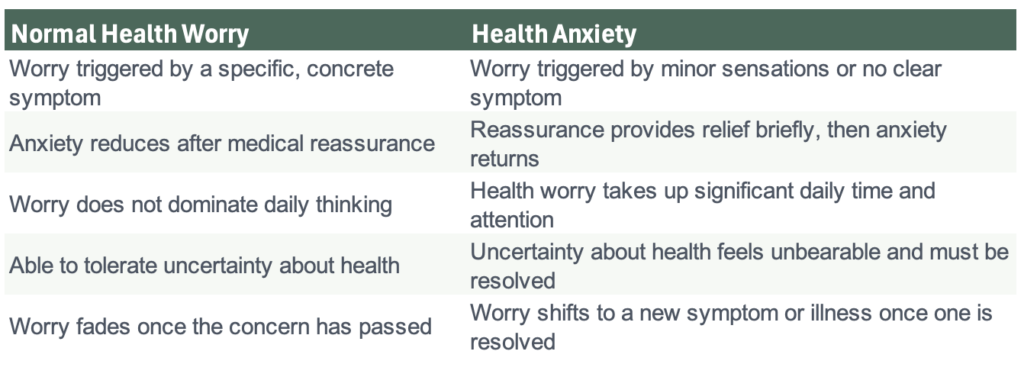
- Health anxiety is not simply "being a worrier." It is a recognised condition in which illness worry takes on a life of its own, consuming hours of the day and significantly reducing quality of life.
- The physical symptoms of health anxiety, including racing heart, tingling, muscle tension, and dizziness, are real. They are produced by anxiety itself, not by the illness you fear.
- Reassurance-seeking, whether through Google, repeated GP visits, or asking loved ones, gives temporary relief but makes health anxiety worse over time. This is a well-documented feature of the maintaining cycle.
- NICE guidelines recommend CBT as the first-line psychological treatment for health anxiety, typically delivered over 8 to 16 sessions with an accredited therapist.
- Research shows that CBT for health anxiety produces large, lasting improvements. Treatment gains are well maintained years after therapy ends (PMC, 2020).
What Is Health Anxiety?
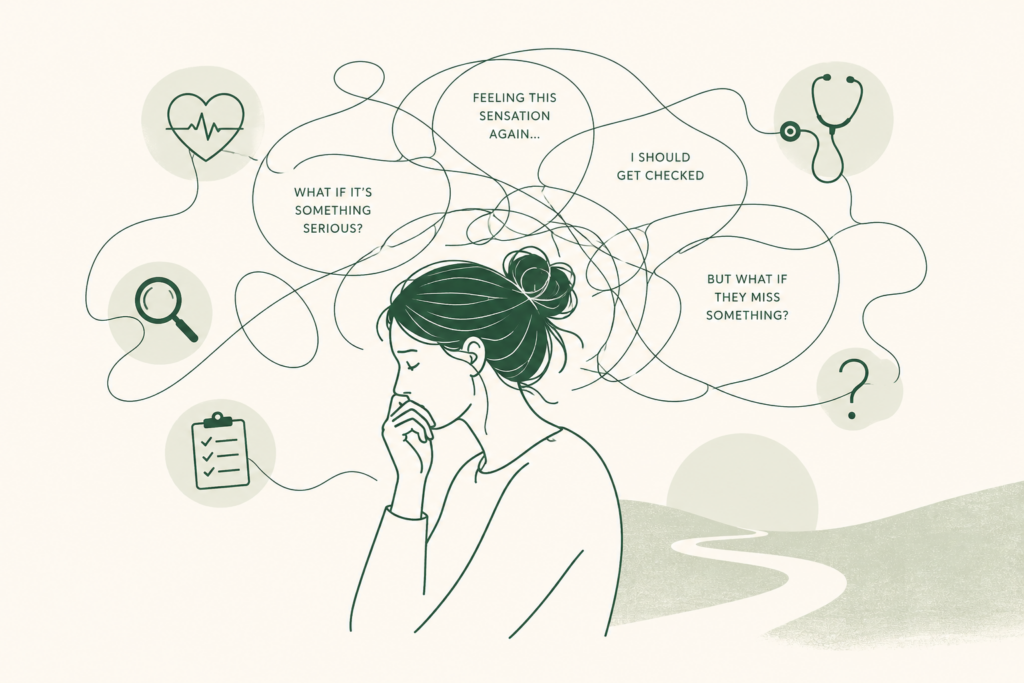
You notice something. A headache that has lasted a little longer than usual. A mole that seems slightly different. A twinge in your chest. Most people register the sensation, decide it is nothing, and move on. But if you have health anxiety, the worry does not move on. Instead, it grows. You find yourself checking, searching, asking, and returning to the same uneasy thought: what if this is something serious?
Health anxiety, sometimes called illness anxiety disorder, is a condition in which fear of having or developing a serious illness becomes persistent, distressing, and difficult to control. It is not about being "dramatic" or lacking willpower. It is a genuine psychological condition with a clear maintaining mechanism, and it is more common than most people realise. According to the NHS, health anxiety can affect anyone at any age, and it is closely related to obsessive compulsive disorder in the way the worry operates.
What makes health anxiety particularly difficult is that it feeds on uncertainty. The human body is full of sensations, most of them meaningless, but health anxiety turns every one of them into a potential catastrophe. You are not imagining that something feels wrong. The sensations are real. What the anxiety does is interpret those sensations in the most frightening way possible, and then keep you locked in a cycle of checking and worry that prevents you from ever feeling settled.
NHS: Health anxiety is when you spend so much time worrying you are ill, or going to get ill, that it starts to take over your life. It is related to obsessive compulsive disorder in the way the anxious thoughts behave and respond to reassurance.
Related Articles: Does Online CBT Work for Anxiety? | Difference Between Health Anxiety & OCD
What Are the Symptoms of Health Anxiety?
Health anxiety shows up in both the mind and the body, and understanding both is essential. Many people are surprised to discover that anxiety itself produces convincing physical symptoms that can be mistaken for the very illness they fear. This is not coincidence. It is one of the reasons health anxiety is so self-sustaining.
Psychological symptoms
The mental experience of health anxiety usually centres on a specific fear, often cancer, heart disease, neurological illness, or another serious condition that feels impossible to dismiss. Common signs include persistent worry about being seriously ill, difficulty accepting medical reassurance, fear that doctors have missed something, and a constant sense of dread that is hard to put down even for a few hours.
Alongside the core fear, many people find themselves drawn to behaviours that feel like they should help but ultimately make things worse. Searching symptoms online, asking friends or family members for reassurance, repeatedly checking for signs on the body, and avoiding anything health-related in the media are all extremely common. According to Anxiety UK, these behaviours are a defining feature of the condition rather than a sensible response to a genuine risk.
Physical symptoms produced by anxiety
This is the part that catches many people off guard. When you are anxious, your body activates the stress response. This produces measurable, real physical changes. Your heart rate increases. Your muscles tense. Your breathing becomes shallower. Blood is redirected to major muscle groups. The result is a collection of physical sensations that closely mimic the symptoms of serious illness, including a racing heartbeat, shortness of breath, dizziness, tingling in the hands or feet, headaches, stomach upset, and chest tightness.
In health anxiety, these anxiety-driven symptoms are precisely what the worried mind is scanning for. You notice a tight chest, interpret it as a potential cardiac symptom, and your anxiety rises. The higher anxiety increases the chest tension further, producing more sensation, which feels like more evidence. This loop is the engine of health anxiety, and it operates entirely independently of whether there is any genuine physical problem.
Why the Health Anxiety Cycle Is So Hard to Break
Understanding the cycle is the first genuinely useful step. Most people with health anxiety have tried willpower. They have told themselves to stop Googling, stop checking, stop asking. It does not tend to work for long, and there is a clear reason why.
The health anxiety cycle works like this. You notice a sensation or a thought about illness. The anxiety rises, and the discomfort becomes difficult to sit with. You take an action to reduce the discomfort, whether that is searching symptoms, checking your body, seeking reassurance, or visiting a doctor. The anxiety drops, often immediately. This reduction in anxiety feels like the action worked. But what has actually happened is that you have reinforced the idea that the worry was worth taking seriously, and that checking or seeking reassurance is how you resolve it.
The relief is temporary. The anxiety returns, often stronger, and the threshold for triggering it becomes lower over time. This is why health anxiety typically escalates rather than resolves without treatment. Each reassurance-seeking episode makes the next one more likely, not less. Mind UK describes this pattern across anxiety conditions: the avoidance and safety-seeking that feels protective is precisely what maintains the fear.
The role of "Googling symptoms"
Searching symptoms online deserves its own mention because it is so pervasive, and because it is almost uniquely unhelpful for anyone prone to health anxiety. Search engines optimise for engagement, not reassurance. A search for "headache and neck tension" will surface articles about meningitis before it surfaces articles about stress or dehydration. The information is not wrong, but the weighting is consistently alarming for someone already primed to interpret sensation as threat. In CBT for health anxiety, reducing compulsive symptom-searching is one of the first behavioural targets, not because curiosity is harmful, but because in this context the searching functions as reassurance and maintains the cycle.
WORKING WITH A THERAPIST
Recognising this pattern in yourself is the first step. CBT is designed to interrupt it at every point in the cycle.
What CBT for Health Anxiety Actually Involves
CBT for health anxiety is not general talking therapy. It is a structured, evidence-based treatment that targets the specific thoughts, behaviours, and physical responses that maintain the condition. NICE clinical guidelines recommend CBT as the first-line psychological treatment for health anxiety, and the research base is substantial. A landmark long-term study published in the British Journal of Psychiatry found that CBT treatment gains for health anxiety were not only significant at the end of therapy, but remained stable at a 10-year follow-up with no meaningful deterioration.
Treatment typically runs for 8 to 16 weekly sessions of around 50 to 60 minutes. What happens within those sessions follows a clear and purposeful structure.
Psychoeducation: understanding the cycle
The first task is making sense of what is happening. When you understand that the physical sensations are real but generated by anxiety, that the reassurance-seeking is maintaining rather than resolving the problem, and that the cycle has a predictable structure, you gain something that anxiety cannot easily take away: a framework. This is not just about information. It shifts the relationship with the symptoms from one of threat to one of understanding.
Identifying and testing unhelpful beliefs
Health anxiety is maintained by specific patterns of thinking, including overestimating the likelihood of serious illness, catastrophising ambiguous sensations, and underestimating your ability to cope with uncertainty. In CBT, you learn to identify these thought patterns and to test them, not by seeking reassurance, but by collecting evidence and considering alternative interpretations. This is active work, not passive reflection.
Behavioural experiments and dropping safety behaviours
This is where the real change happens. Safety behaviours are the actions you take to manage the anxiety: checking, Googling, avoiding, seeking reassurance. In CBT, you gradually reduce these behaviours and allow yourself to tolerate uncertainty without carrying out the check. This is not about forcing yourself to feel fine. It is about discovering, through direct experience, that the feared outcome does not materialise, and that you can tolerate the discomfort of not knowing without something catastrophic happening.
Attention retraining
Health anxiety narrows attention onto the body. Small sensations that would go unnoticed in most people become amplified because you are scanning for them constantly. CBT includes specific techniques for broadening attention and reducing body-focused monitoring, which directly reduces the frequency and intensity of the sensations that trigger the worry.

What Recovery From Health Anxiety Looks Like
Recovery from health anxiety does not mean never noticing a bodily sensation, or never having a worried thought about your health. That would not be realistic, and it is not the goal. What changes is your relationship with those thoughts and sensations. They arise, and instead of triggering the cycle, you are able to notice them, place them in context, and let them pass without acting on them.
In practical terms, this often means spending fewer hours each day occupied by health worry. It means being able to sit with a headache without immediately searching for the worst explanation. It means visiting a GP when something genuinely warrants it, rather than repeatedly and compulsively, and being able to accept the outcome. It means being present in conversations, at work, and in relationships, instead of mentally absent because the worry has taken over.
Research consistently supports this picture. A 2020 review published in the British Journal of Psychiatry Open found that patients who completed CBT for health anxiety showed large improvements on all primary outcome measures at the end of treatment, with gains maintained at both one-year and ten-year follow-up. This is not a condition where treatment works briefly and then fades. For most people, the skills learned in CBT continue to compound over time.
British Journal of Psychiatry Open (2020): Long-term follow-up of CBT for health anxiety showed no statistically significant deterioration from post-treatment to 10-year follow-up, suggesting that treatment benefits are durable and that the skills learned continue to provide protection against relapse.
If health anxiety has been present for a long time, the early sessions of therapy can feel counterintuitive. Reducing checking feels risky. Sitting with uncertainty feels almost impossible. This is normal, and it is something a good CBT therapist will anticipate and work through with you at a pace that is manageable. Progress is not linear, but it is reliably possible.
CONSIDERING TREATMENT?
Curious whether CBT could help with what you have been experiencing?
A free 15-minute consultation is a low-pressure place to think it through. No forms, no obligation. I will be honest about whether what I offer is a good fit for what you are dealing with.
No referral needed · Sessions £100
BABCP Accredited · Online · London & UK
Frequently Asked Questions
READY TO TAKE THE NEXT STEP?
You've been living with this long enough.
Health anxiety is exhausting in a way that is hard to explain. The worry follows you, and the reassurance never quite lasts. If that pattern sounds familiar, it is also one that responds well to the right treatment.
I am a BABCP accredited CBT therapist specialising in health anxiety. Sessions target the maintaining cycle, the safety behaviours keeping you stuck, and rebuilding your tolerance for uncertainty. Available online across the UK and in London. A free 15-minute consultation is the easiest place to start.
ABOUT THE AUTHOR
Who writes this?

Evelynne R. Scott-McFarlane
BABCP ACCREDITED CBT THERAPIST
I'm a BABCP accredited CBT therapist specialising in anxiety - OCD, health anxiety, and panic disorder. I trained at King's College London and work online with clients across London and the UK.
I write these articles because good information is hard to find. Most mental health content online is either too vague to be useful or too clinical to be readable. I'm trying to do something different