Types of OCD: The 7 Most Common Forms Explained
QUICK ANSWER
OCD takes many different forms. The type of intrusive thought at the centre varies between people, but the cycle is always the same: an unwanted thought triggers anxiety, a compulsion temporarily relieves it, and the doubt comes back stronger than before. Recognising the specific subtype matters because each responds best to a slightly different clinical approach.
KEY TAKEAWAYS
- OCD affects around 750,000 people in the UK at any one time (OCD-UK, 2024)
- People in the UK wait an average of 6 to 7 years before seeking help after symptoms start (OCD Action, 2024)
- Contamination OCD is the most recognised form, but Harm OCD and ROCD are reported more widely in OCD communities
- Pure O is among the most misdiagnosed subtypes because there are no visible compulsions
- CBT with Exposure and Response Prevention (ERP) helps 75% of people with OCD significantly (OCD-UK, 2024)
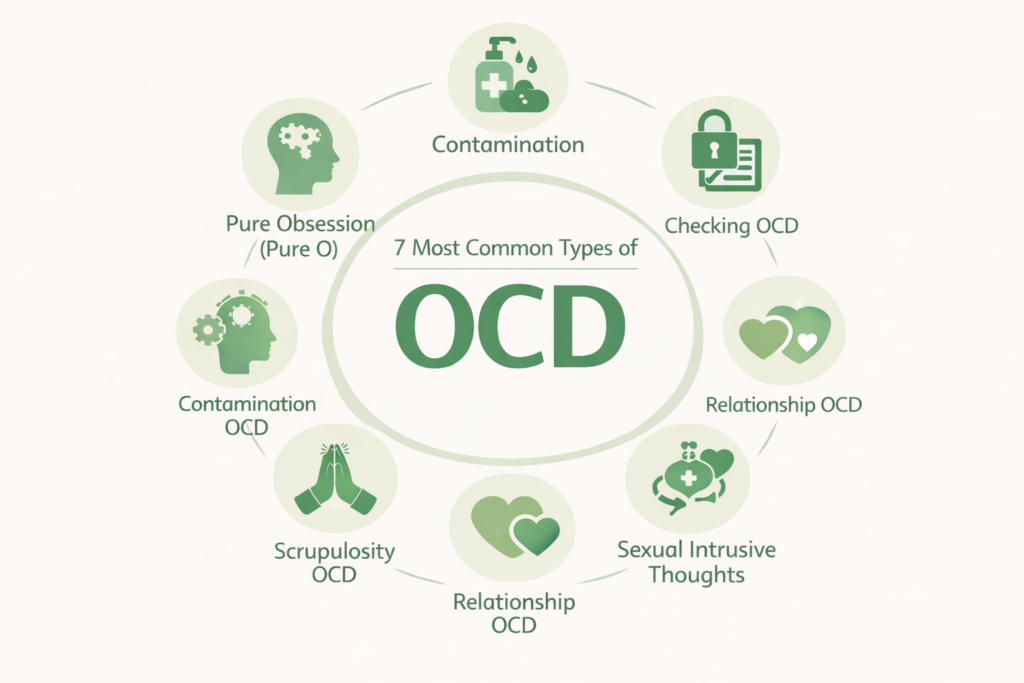
Most people picture OCD as hand-washing. Or checking the stove. And yes, those are real. But they don't begin to cover it.
OCD affects roughly 750,000 people in the UK at any one time (OCD-UK, 2024). A lot of them have spent years wondering whether what they're experiencing counts, because it doesn't look like what they expected. Someone with Harm OCD isn't washing their hands. Someone with Pure O might not be doing anything visible at all.
Getting the right name for what you're going through matters. It shortens the gap between confusion and help. In the UK, people wait an average of 6 to 7 years before seeking treatment, partly because they don't recognise their own symptoms as OCD (OCD Action, 2024).
This post breaks down the 7 most common forms: what they look like, how they work, and why each one tends to get missed.
What are 'types' of OCD, exactly?
The DSM-5 doesn't officially list OCD subtypes. Clinicians tend to group them by theme, the content of the obsessions. What matters isn't the label. It's the cycle: intrusive thought, anxiety, compulsion, temporary relief, then the thought comes back, usually louder.
That said, knowing the theme helps. Particularly when someone has spent years not recognising their experience as OCD at all. Different forms get missed for different reasons, and the sooner someone has a name for it, the sooner they can find the right help.
1. Contamination OCD

The most recognised form. Contamination OCD involves obsessive fears about germs, illness, chemicals, or 'dirtiness', paired with compulsions like washing, cleaning, or avoiding specific surfaces or objects.
About 26.5% of people in OCD communities experience contamination OCD (NOCD, 2023), and nearly 60% of people with OCD engage in cleaning rituals at some point (StatPearls, 2023).
It's not always about hygiene in the conventional sense. Some people aren't afraid of illness, they're afraid of spreading harm to others, or the contamination feels moral or emotional rather than physical. The fear, at its core, is that contact with something 'contaminated' will lead to consequences they can't tolerate or undo.
The compulsion makes sense in the moment. Wash once, feel better. The problem is the relief is short-lived, and the threshold for 'clean enough' keeps rising. Over time, the rituals tend to expand rather than contain the anxiety.
2. Checking OCD
Did I lock the door? Did I turn the gas off? Did I send that email to the wrong person? Did I accidentally run someone over without realising?
Checking OCD centres on doubt, specifically, the fear that failing to check will result in harm. The compulsion is to verify. And then verify again. And then one more time, because maybe you weren't really paying attention the first time.
Here's what makes this form particularly persistent: checking doesn't reduce the doubt. It amplifies it. Each check confirms to the brain that the situation was genuinely dangerous and that checking was necessary. The anxiety threshold rises. The checking has to increase to produce the same temporary relief.
Checking compulsions aren't always physical. Mental checking: replaying memories, going over a conversation to make sure you didn't say something offensive, searching your own mind for certainty about something, is just as common, and considerably harder to spot.
3. Pure O - Purely Obsessional OCD
'Pure O' is one of the most commonly misunderstood forms. The name implies there are no compulsions, but that's not quite accurate. The compulsions are mental rather than behavioural.
Someone with Pure O experiences the same kinds of intrusive thoughts as anyone else with OCD: violent images, taboo sexual thoughts, fears about their own morality or intentions. What makes it 'pure' is that they don't perform visible rituals in response. Instead, they ruminate. They seek mental reassurance. They analyse the thought to determine whether it means something about who they really are.
Pure O gets missed, sometimes for years, because from the outside, nothing looks wrong. Internally, the person can be spending hours every day fighting their own mind. It's one of the most commonly undiagnosed OCD presentations, partly because the person doesn't look like what most people imagine when they think of OCD.
If you've ever had a thought that horrified you and then spent hours trying to disprove it, reassure yourself about it, or avoid whatever triggered it, that pattern is worth paying attention to.
4. Harm OCD

Harm OCD involves intrusive thoughts or fears about causing harm to others, or, less commonly, to oneself. About 31.8% of people in OCD communities identify this as something they experience (NOCD, 2023).
These thoughts are deeply distressing precisely because they conflict with what the person actually values. Someone with Harm OCD who has intrusive thoughts about hurting their child is not dangerous. They're horrified. The thought appalls them. That horror is OCD working exactly as it does, latching on to whatever matters most.
Common compulsions include avoiding knives or sharp objects, seeking reassurance from others that they're 'not a bad person,' or mentally reviewing their intentions after every interaction with someone they care about.
A clinical distinction worth knowing: genuine harmful intent doesn't typically produce distress. Harm OCD produces enormous distress. That's one of the first things a specialist will look for, and it matters for getting the right support.
5. Relationship OCD (ROCD)
Over 51% of people in OCD communities report experiencing relationship OCD, making it one of the most widely reported subtypes (NOCD, 2023).
'Do I really love them? Are they the right person? What if I'm only staying out of habit?' These thoughts don't feel like worries to the person experiencing them. They feel like important questions that need answering before they can relax. So they investigate.
The compulsions: constant self-analysis. Seeking reassurance from a partner. Comparing the relationship to others. Mentally testing feelings during intimacy or ordinary moments. Googling 'how do you know if you love someone' at 2am.
The particularly cruel thing about ROCD is that checking never resolves the doubt. The more you interrogate a relationship looking for certainty, the more uncertain it feels. The OCD is using the relationship, something the person cares deeply about, as its subject matter. That's not a coincidence.
6. Sexual intrusive thoughts and POCD
This is one of the subtypes people are least likely to talk about, and most likely to suffer with in silence.
Sexual OCD involves intrusive sexual thoughts that feel completely contrary to who the person is and what they want. POCD refers specifically to intrusive sexual thoughts involving children.
People with these presentations are often too ashamed to seek help. They misinterpret the thought as evidence of desire or intent. It isn't. In OCD, intrusive sexual thoughts are distressing precisely because they conflict with the person's values, that's what makes them OCD rather than desire.
Research going back to Rachman and de Silva (1978), replicated multiple times since, found that around 94% of people experience intrusive thoughts, including sexual and disturbing ones. The difference in OCD is what happens next: the thought becomes evidence of something terrible about the person who had it. That shift is where the suffering lives.
7. Scrupulosity — religious and moral OCD
Scrupulosity is OCD centred on religious observance, morality, or both. Between 10% and 33% of people with OCD report religious obsessions (StatPearls, 2023), though that varies significantly by culture and context.
Someone with scrupulosity might fear they've committed blasphemy, that they're inherently sinful, or that their prayers weren't performed 'correctly enough.' Compulsions often involve excessive prayer, repeated confession, seeking reassurance from religious figures, or, at the other extreme, avoiding religious settings entirely because being there makes the obsessions worse.
Moral scrupulosity looks similar but isn't tied to religion. Obsessional fears about honesty, accidentally causing harm, fairness, or being a 'good enough' person can drive the same cycle without any religious content at all.
Scrupulosity is associated with higher rates of depression and can be harder to treat than some other subtypes, partly because the compulsions are embedded in genuine beliefs or practices that have meaning to the person (PubMed, 2025). This is one form where finding a therapist with specific experience really does make a difference.

Why does OCD look so different from person to person?
OCD is one condition, not seven. What changes across these presentations is the theme of the obsessions, the specific fears driving the cycle. The structure underneath is always the same.
What tends to vary is what the brain has decided to fixate on. And it's almost always something the person cares deeply about. A person who values safety fears causing harm. A person with strong faith fears blasphemy. A person who values their relationship fears not really loving their partner.
OCD is sometimes described as a disorder of conscience. That's not because people with OCD have something wrong with their values, it's the opposite. The condition latches on to what those values make feel important, and runs with it.
When should you seek help?
If any of the types above resonate, if you're spending significant time each day on intrusive thoughts or compulsions, or if your daily life has narrowed around triggers, it's worth speaking to someone who specialises in OCD.
CBT with Exposure and Response Prevention (ERP) is the evidence-based treatment, and it works. Research shows 75% of people achieve significant improvement, with one-third reaching full recovery (OCD-UK, 2024). The sooner treatment starts, the less time OCD has to expand its grip.
The average delay before seeking help in the UK is 6 to 7 years. You don't have to wait that long.
In summary
OCD isn't one thing. What changes across these seven forms is the story, the specific fear OCD has decided to build its cycle around. The cycle itself doesn't change.
If you've been reading through this and recognising something, that recognition matters. It's information. And it can be the starting point for getting help that actually fits what you're experiencing.
Frequently Asked Questions
READY TO TAKE THE NEXT STEP?
Ready to get help for OCD?
ABOUT THE AUTHOR
Who writes this?

Evelynne R. Scott-McFarlane
BABCP ACCREDITED CBT THERAPIST
I'm a BABCP accredited CBT therapist specialising in anxiety - OCD, health anxiety, and panic disorder. I trained at King's College London and work online with clients across London and the UK.
I write these articles because good information is hard to find. Most mental health content online is either too vague to be useful or too clinical to be readable. I'm trying to do something different